
Summary
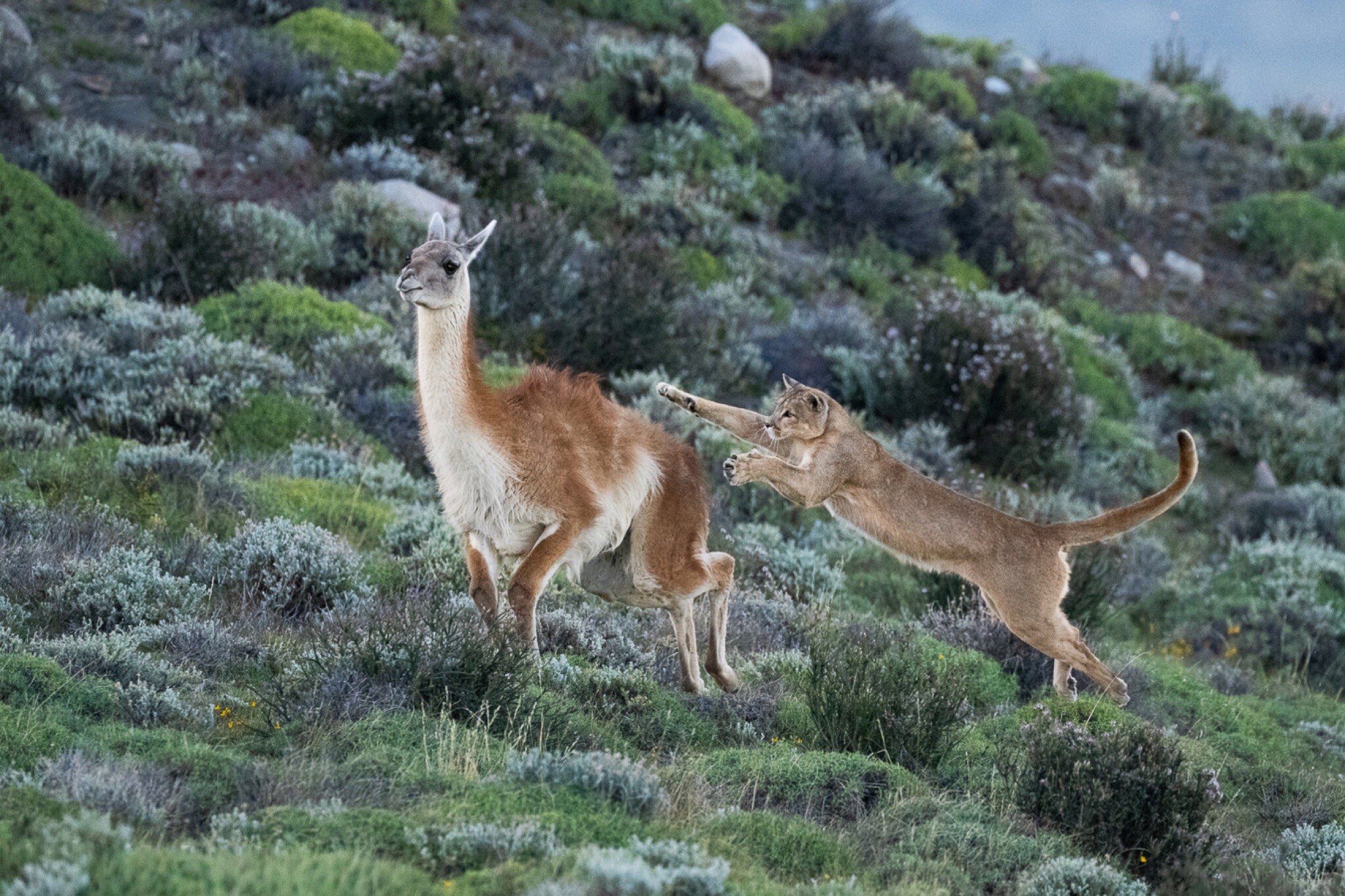
Torres del Paine National Park in Chilean Patagonia holds one of the largest concentrations of Pumas in South America, and the open country along the park's eastern flank — the northern coast of Sarmiento Lake, Laguna Amarga and Laguna Azul — is where these cats hunt. Working with expert local trackers and spotters, we search at first light and again in the evening, when the Pumas are most active; we have a 100% success rate to date.
Around the tracking there is no shortage of other subjects: Guanaco herds on the golden steppe, Andean Condor riding the ridgelines, Huemul, Chilla and Culpeo Foxes, Darwin's Rhea and the iceberg-strewn shoreline of Grey Lake, all set against the Paine massif.
The tour spends ten nights on the ground in Chile — an arrival night in Santiago ahead of the flight south, then nine nights in Patagonia itself. It is designed for wildlife photographers: long, flexible sessions in the field, with movements dictated by sightings and light rather than a fixed timetable.
Itinerary
Santiago
Arrive in Santiago and overnight, ready for the flight south to Patagonia the following morning.
Punta Arenas
Fly south from Santiago to Punta Arenas, on the north shore of the Strait of Magellan, and settle in for the night at a comfortable hotel overlooking the strait.
Hosteria Pehoe · Torres del Paine
We leave Punta Arenas after breakfast and drive north through open pampas, past flamingo-lined lakes and herds of Guanaco, to Torres del Paine National Park. Our base for the next seven nights is Hostería Pehoé, a simple but charming hotel on a small island in Lake Pehoé with views of the Towers of Paine. There is time to be out on the park's eastern flank for the first evening search.
Hosteria Pehoe · Torres del Paine
Six full days of Puma tracking with our expert local trackers and spotters, searching early morning and evening across the hunting grounds on the park's eastern flank — the northern coast of Sarmiento Lake, Laguna Amarga and Laguna Azul, one of the largest Puma concentrations in South America. Between searches there is no shortage of subjects: Guanaco, Huemul (Andean Deer), Patagonian Hog-nosed Skunk, Hairy Armadillo, Chilla and Culpeo Foxes, Andean Condor, Darwin's Rhea, Torrent Duck, Magellanic Woodpecker, Silvery and White-tufted Grebes, and raptors from Black-chested Buzzard-Eagle to Crested Caracara and Cinereous Harrier. There is also the iceberg-strewn shoreline of Grey Lake.
Punta Arenas
A final dawn search on the eastern estancias before the drive back across the pampas to Punta Arenas, with a last chance of Guanaco, Condor and Rhea along the way. Final night in Punta Arenas.
Depart Punta Arenas.
Photography notes
This is on-foot tracking of a genuinely wild cat, and that shapes everything about the photography. The pumas in and around Torres del Paine are not baited, drawn to hides or photographed from a vehicle — expert local trackers find them by reading the ground, glassing the hillsides and knowing the individual cats' patterns, and then we walk in on foot across open Patagonian steppe and through pockets of lenga forest to get into position. Distances vary enormously: some encounters are a cat resting or moving on a distant slope, others are far closer as a puma works along a ridge or crosses the steppe, so a long zoom is the honest workhorse here — a 100-400mm or a 200-600mm on a full-frame or high-quality mirrorless body covers most of what the day throws at you. Add a fast prime (a 300mm, 400mm or 500mm) for the distant cat in low light, and genuinely do carry a wide-to-standard lens (16-35mm or 24-70mm): some of the strongest images are the puma small against the Paine massif, the guanaco herds on the golden steppe, or the whole immense landscape, and the wide lens is worthless left in the vehicle when the cat finally sits below those mountains. Bring your own binoculars — you will spend a great deal of the day finding and following animals at distance before the camera ever comes up.
The light and the weather are the defining challenge, more so than in almost anywhere else we work. Pumas are most active at the edges of the day, so the best chances come at dawn and dusk in low, raking, often flat light — push your ISO without hesitation and keep your shutter speed up (1/1000s and faster for a walking or hunting cat), because a clean high-ISO file beats a slow, 'correct' exposure that smears the moment. The Patagonian wind is ferocious and near-constant; it will buffet a long lens hard, so shoot handheld or off a monopod rather than a tall tripod, brace low behind rocks and terrain where you can, and expect to fight camera shake as much as anything. The weather changes by the minute — sun, cloud, sleet and rain can pass through in an hour, and the massif appears and vanishes behind cloud — so keep a rain cover and cloths to hand and be ready to work fast when the light breaks. Anticipate behaviour rather than chase it: guanaco are the puma's main prey, and a herd suddenly alert, alarm-calling and staring in one direction will often tell the trackers where a cat is before you can see it, so watch the guanaco as much as the ground. Keep a body ready, too, for Andean condors riding the wind off the ridgelines, for grey and culpeo foxes, and for the wider scene of steppe, lakes and the towers that make this one of the great wildlife landscapes on Earth.
What to bring
Camera equipment
- A long zoom as your workhorse — a 100-400mm or 200-600mm on a full-frame or high-quality mirrorless body covers most encounters, from a distant cat on a slope to one much closer along a ridge
- A fast telephoto prime (300mm, 400mm or 500mm) for the distant cat in the low dawn and dusk light
- A wide-to-standard lens (16-35mm or 24-70mm) for the puma-in-landscape frame against the Paine massif, the guanaco herds and the wider steppe
- A monopod rather than a tall tripod — you cover ground on foot and the wind makes a high tripod a liability; a monopod steadies a long lens without catching the gale
- A second body if you have one, so you are not changing lenses in wind, dust and blowing rain
- Plenty of spare batteries kept warm inside a jacket, and plenty of memory cards plus a drive to back up nightly
- A rain cover and several lens cloths for sleet, rain and spray, and a padded, weather-resistant bag for the walk in
- Your own binoculars — essential for finding and following cats and guanaco at distance before the camera comes up
Clothing
- Serious layering built for cold, wet, extremely windy conditions — a merino or synthetic base layer, a warm fleece or insulated mid layer, and a warm insulated jacket for standing still at dawn and dusk
- A genuinely windproof and waterproof shell — jacket and over-trousers — this is the single most important item, as the Patagonian wind and rain are relentless
- Warm hat, a buff or neck gaiter, and warm gloves (thin liners you can shoot in are ideal, with warmer gloves over the top)
- Sturdy, broken-in, waterproof hiking boots — you walk on rough, uneven ground and boots that are new or ill-fitting will ruin the trip
- A trekking pole (or a pair) for stability on rough terrain and loose slopes
- Warm wool socks and dry spares, plus a change of dry base layers for the evenings
- Sunglasses and a warm hat for cold mornings and evenings — the wind bites even when the sun is out
Documents, health & practical
- Check the current passport and entry requirements for Chile for your nationality well before departure, and carry copies separately from the originals
- Comprehensive travel insurance that covers photographic equipment and remote-area medical evacuation — this is rugged, remote terrain a long way from a major hospital
- A reasonable level of fitness for hiking on rough, uneven ground — the elevation is low to modest here, so the demand is on your legs, stamina and footing rather than altitude
- Strong sun and wind protection — high-factor sunscreen, lip balm and a wind-cutting layer for the face; the Patagonian sun and wind burn even on cool days
- A small personal medical kit: blister care for long days on foot, any personal medication in its original packaging, painkillers and remedies for stomach upsets
- No anti-malarials or tropical vaccinations are needed for this region — but check routine boosters and your own doctor's advice before travel
- A reusable water bottle and high-energy snacks for long days in the field, and a headlamp for early starts and dark returns
Inclusions / Exclusions
Please contact us for more information and to talk through dates, group size and photographic priorities.
Inclusions
- All accommodation with private facilities
- All meals during the tour
- Expert local naturalist guides and puma trackers
- Ground transport throughout Chilean Patagonia
- National park entry fees
- Domestic flight, Santiago to Punta Arenas
Exclusions
- International flights
- Tips
- Travel insurance
- Soft drinks and alcoholic drinks