Summary
Madagascar has been an island for roughly 88 million years, and almost everything that walks, climbs or calls on it evolved there and nowhere else. This is a fifteen-day, privately-guided small-group trip across three completely different Malagasy habitats, built around the lemurs and the light rather than a species checklist.
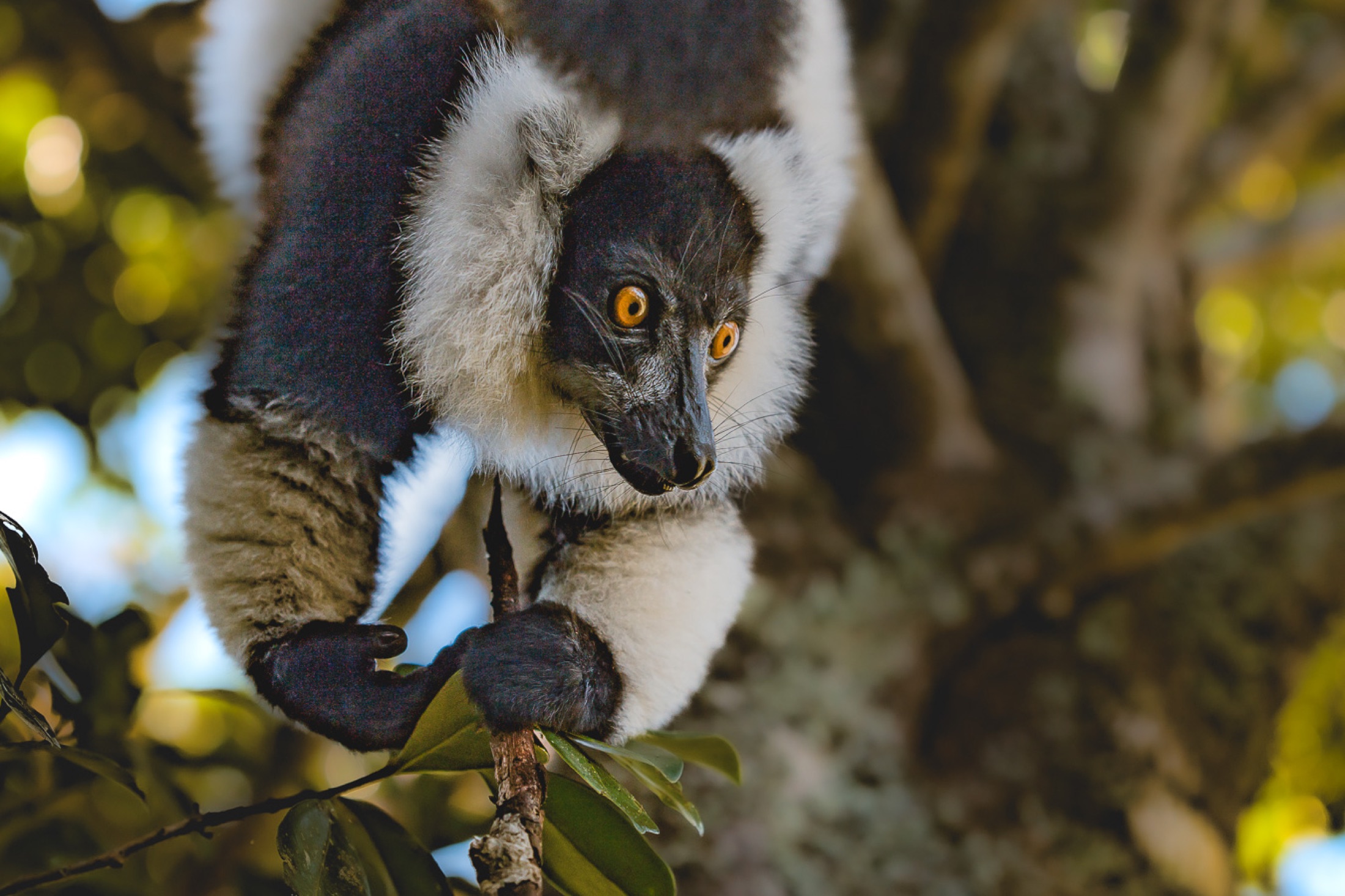
It opens in the eastern rainforest at Andasibe-Mantadia, where Indri — the largest living lemur — call across the valleys at dawn, and diademed sifaka, woolly lemurs and a long list of chameleons and leaf-tailed geckos work the forest around the lodge. It then crosses to the dry west: Morondava for the Avenue of the Baobabs at sunrise and sunset, and three nights at Kirindy, the best place in the country for Verreaux's sifaka, Madame Berthe's mouse lemur and the fossa, Madagascar's largest carnivore.
The trip finishes deep in the spiny south at Berenty, where ring-tailed lemurs and 'dancing' Verreaux's sifaka move on open ground in good light — the most photographable lemurs in the country — before the flight home from Fort Dauphin. Fourteen nights, timed for May and June, at the start of the dry season when the forests are still green, the roads are passable and lemur activity is high.
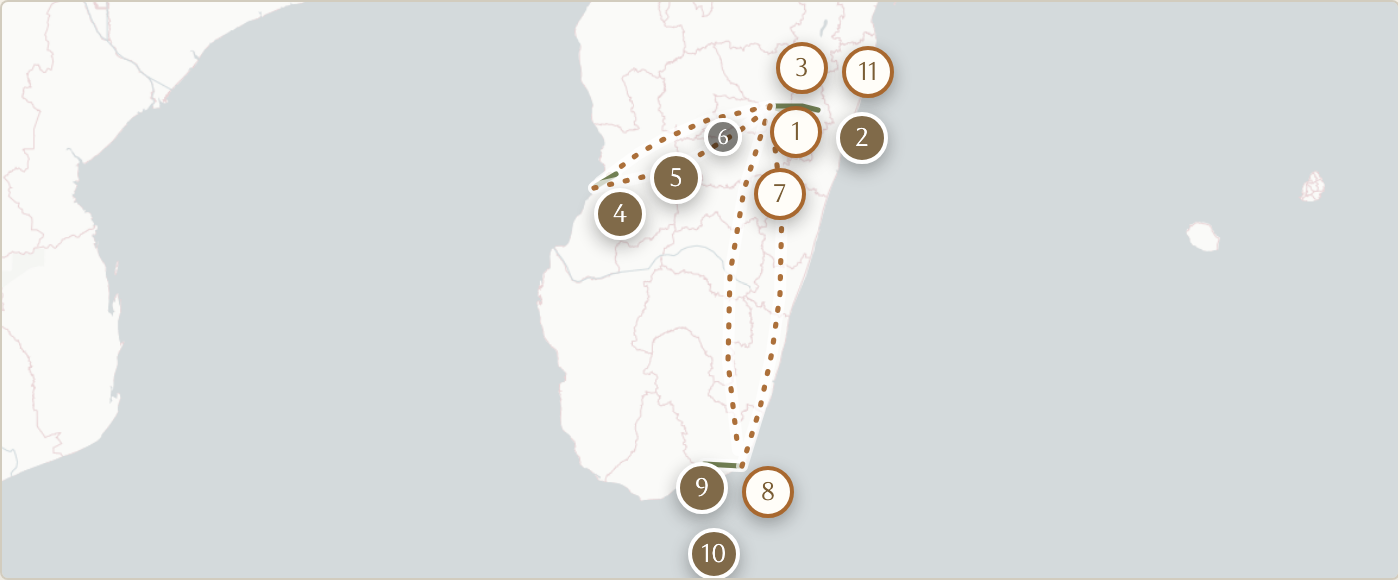
Itinerary
Relais des Plateaux
Arrival in Antananarivo (Tana). Land in Madagascar’s capital and overnight to rest and prepare for the adventure ahead.
Vakona Forest Lodge
Transfer east to the lush rainforests of Andasibe. This is the land of the Indri, Madagascar’s largest lemur. We will spend two days photographing Indri and Diademed Sifaka in golden morning light; tiny frogs, chameleons, and orchids on macro walks; night walks for mouse lemurs and leaf-tailed geckos; bird endemics including blue vanga, asity and ground-rollers.
Palissandre Côte Ouest
Transfer back to Tana and fly to Morondava. We will photograph the Avenue of Baobabs in the evening golden light.
Relais du Kirindy
We head into Kirindy, home of the elusive fossa, Madagascar’s top predator. Enjoy dawn and dusk walks to maximise our chances of photographing Fossa, Giant jumping rats, Red-fronted brown lemurs and dry forest birdlife.
Relais des Plateaux
We journey back to Morondava and take the midday flight to Antananarivo, where we overnight in the capital before continuing to the far south.
Berenty Lodge
We fly to the south for an exclusive stay at Berenty Private Reserve. This is lemur heaven – ring-tailed lemurs in morning light, Verreaux’s sifaka doing their famous dancing walk, endemic birds.
Croix du Sud Hotel
We visit Cap du Sud, the most southerly part of Madagascar where now extinct elephant birds used to roam. We can collect fragments of their eggshells on the beach. Return to Fort Dauphin and overnight.
Relais des Plateaux
We fly back to the capital and enjoy a final night in Madagascar. There is the opportunity to visit artisans and markets.
Return flight to the UK.
Photography notes
Madagascar is a walking safari for the camera, not a vehicle-and-beanbag one, and that shapes everything you carry. Most of the wildlife is photographed on foot along forest trails with a local guide, so a hand-holdable telephoto is the workhorse: a 100-400mm or a 500-600mm covers the lemurs, and much of the time you are shooting steeply upward. At Andasibe the Indri and Diademed Sifaka sit high in the rainforest canopy, so expect to work at the long end into dappled, contrasty light, watch your background for hot sky, and be ready to lift ISO to keep a usable shutter speed under the trees. It pays to be patient and let the animals settle and move into a clean gap rather than chasing them. Berenty is the gentler end of the spectrum: the ring-tailed lemurs and the Verreaux's sifaka are relaxed and often at eye level or on the ground, and the sifaka's sideways 'dancing' run across open ground is the set-piece image, best shot low with a fast frame rate and a mid-range zoom so you can keep the whole animal in the leap. Alongside the long lens, budget as much attention on macro: chameleons, leaf-tailed geckos, day geckos, tiny frogs and orchids are a genuine highlight, and a 90-105mm macro plus a diffused flash or a small LED panel earns its place, particularly on the night walks when the reptiles and mouse lemurs come out.
May and June is the start of the cooler, drier season, and it is a deliberate choice: trails are firmer, humidity and rain are lower than the wet months, and the light is more reliable, though rainforest mornings at Andasibe can be genuinely cool and damp with mist that either gifts you atmosphere or costs you light, so work the first and last hours hard and rest through the harsh midday. Dry-forest Kirindy is the wild card of the trip; the fossa are the draw and are sometimes seen around the forest station, but they remain elusive and often appear in low light at dawn and dusk, so a fast body, high-ISO tolerance and quick reactions matter more than reach. Kirindy's dawn and dusk walks also give you the giant jumping rats and red-fronted brown lemurs. The one true landscape opportunity is the Avenue of Baobabs near Morondava, which we shoot in the evening golden light and on into dusk: bring a wide-to-standard zoom and a tripod for the low-light and any silhouette or blue-hour frames, and expect crowds at the classic spot, so it is worth working the side angles and the trees away from the main row.
What to bring
Camera equipment
- Telephoto for the lemurs and birds - a 100-400mm zoom is ideal for walking, with a 500-600mm useful for canopy species like Indri and Diademed Sifaka
- Mid-range zoom (24-70mm or 24-105mm) for the sifaka leaps at Berenty, forest scenes and the Avenue of Baobabs
- Macro lens (90-105mm) - the chameleons, leaf-tailed geckos, day geckos, frogs and orchids are a real highlight, not an afterthought
- A second body if you have one, so you can keep the macro and the telephoto both ready without swapping in the humidity
- Diffused flash or a small continuous LED panel for macro and for the night walks (reptiles, geckos and mouse lemurs)
- A good headtorch for the night walks - keep it off the animals' eyes and let your guide spotlight
- Lightweight tripod or monopod - a tripod for the Avenue of Baobabs at dusk, a monopod to steady the long lens on the trail
- Plenty of memory cards, spare batteries and a nightly backup drive - internal flights limit your kit, so pack storage smartly
- Rain cover for the camera and a good supply of lens cloths and silica gel for the rainforest damp at Andasibe
Clothing
- Lightweight, breathable long-sleeve shirts and trousers in neutral colours - good against sun, thorns and insects on the forest walks
- A warm mid-layer or fleece for the cool, damp rainforest mornings at Andasibe (May-June is the cooler season)
- A packable waterproof or light rain shell - the dry season is drier, not guaranteed dry, especially in the eastern rainforest
- Broken-in walking boots or trail shoes with grip for muddy, uneven forest trails
- Sun hat, sunglasses and high-factor sun protection for the open dry forest at Kirindy and Berenty and the exposed Baobab avenue
- Insect repellent and long layers for dawn, dusk and the night walks
- A small daypack to carry water, a rain layer, lenses and a packed lunch on longer walks
Documents, health & practical
- Check current visa requirements for Madagascar before travel - a tourist visa is normally required and arrangements can change
- Passport valid well beyond the trip, plus printed and digital copies of your key documents and travel insurance
- Antimalarial cover and up-to-date travel vaccinations - see your GP or a travel clinic in good time before departure
- A yellow fever certificate may be required if you are arriving from or transiting a country where it is a risk - check the latest entry rules for your routing
- A personal first-aid kit with rehydration salts, plasters, blister care and any personal medication in your hand luggage
- Insect repellent (DEET or picaridin) and after-bite treatment for the forest and night walks
- Several internal flights on small aircraft mean tight baggage limits - keep cameras, lenses, batteries and documents in your carry-on
- Small denominations of local currency for markets, artisans and tips; card acceptance is limited outside the capital
- Reusable water bottle and a way to treat or refill water, and a universal travel adapter for charging kit overnight
Inclusions / Exclusions
Inclusions
What is included in the tour cost:
- call prior to our departure, with John Haskew, to run through preparations, kit and ensure we are ready to start photographing before arriving
- Meeting on arrival at Antananarivo and transfer to hotel on the first night
- Bed and breakfast at the hotel on the first night
- All road transfers and internal flights in Madagascar
- Full board accommodation for the duration of the stay in Madagascar
- House wines, beers, local spirits and soft drinks
- Park fees
- Community fees
- Experienced, qualified local guide
Exclusions
Not included in the tour cost:
- International flights to Antananarivo
- Madagascar Visa
- Personal travel and health insurance