Summary
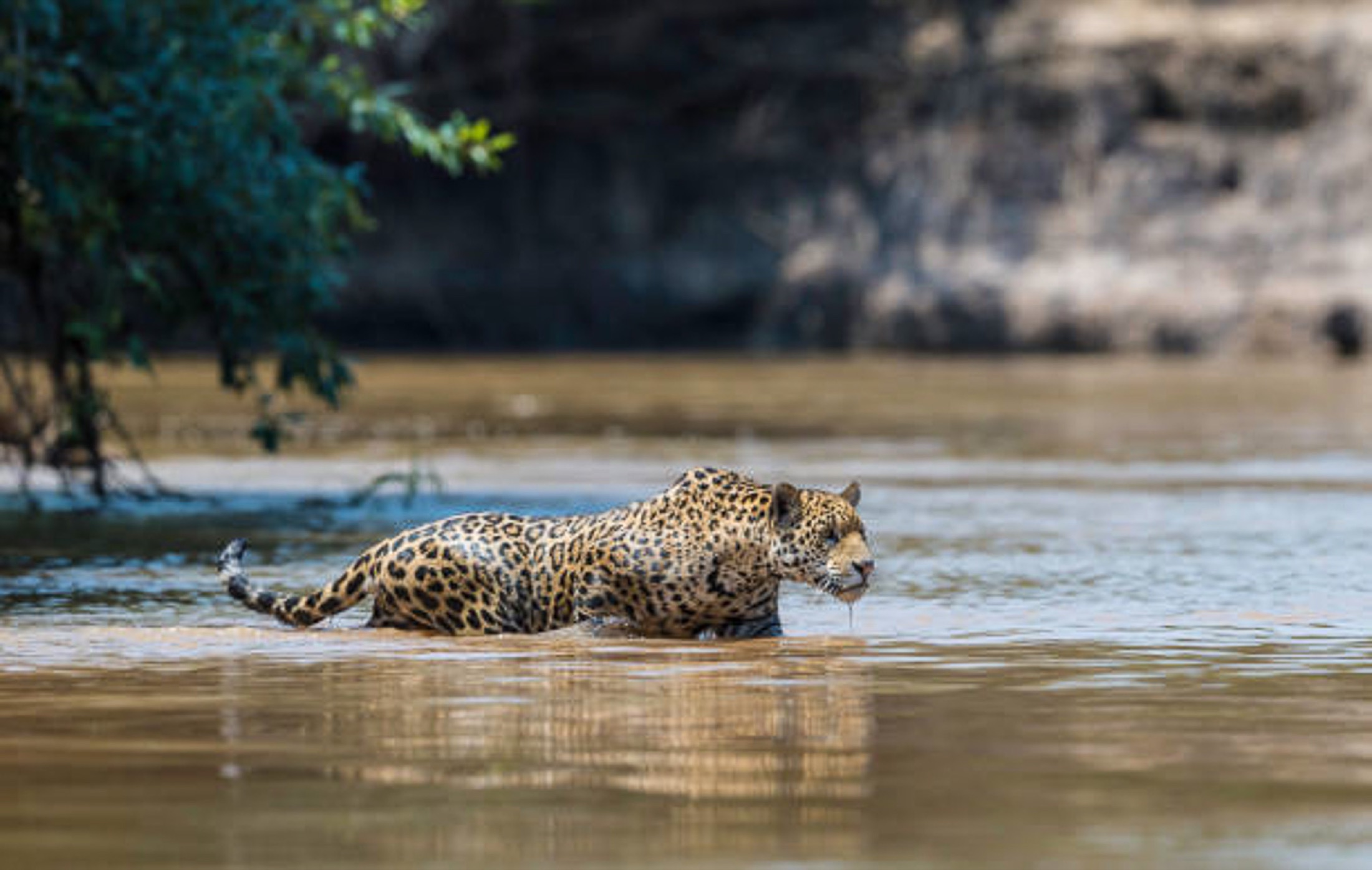
Each year between June and November the dry season drains Brazil's northern Pantanal, and as the water recedes the wildlife concentrates along the shrinking rivers. This safari is built around that window, and around the rivers near Porto Jofre — the best place in the world to photograph Jaguar and Giant River Otter. More than 70 individual jaguars have been photographed in the surrounding area since 2005, and jaguars have been seen on every departure to date.
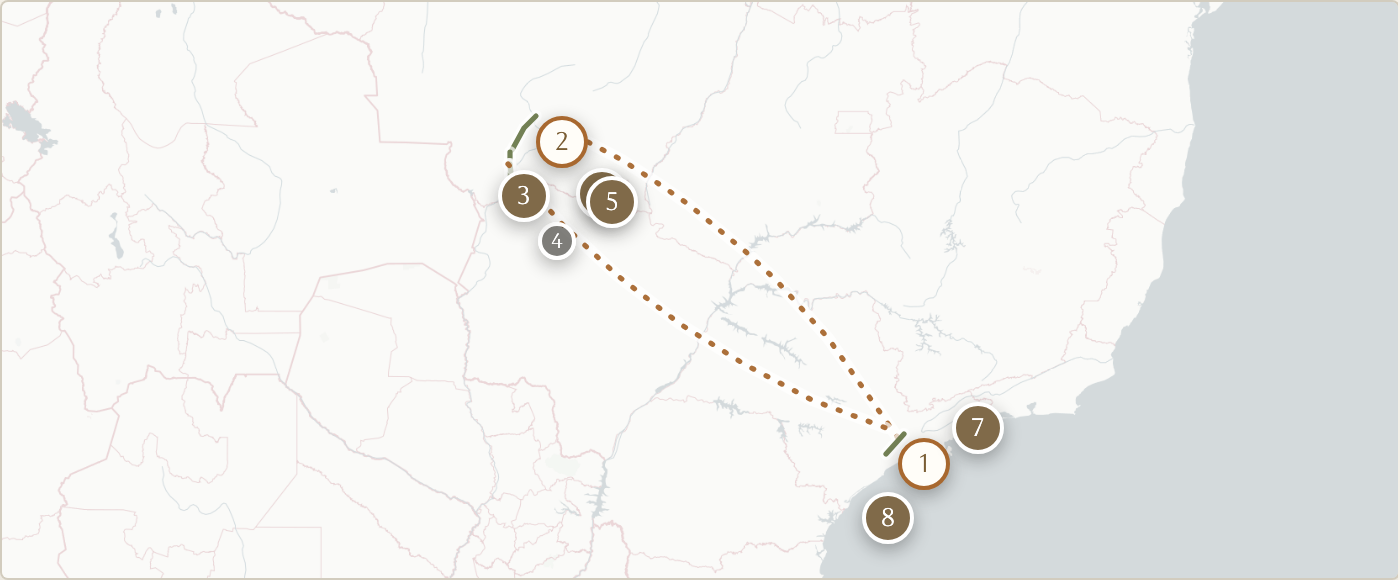
Fourteen days and thirteen nights on the ground follow the 145-km Transpantaneira — a raised dirt road whose roughly 122 wooden bridges turn even the transfers into game drives — from the mammal-rich entrance driveway of Pouso Alegre to four nights aboard the Jaguar Flotel, the only permanent accommodation in the centre of the "Jaguar Zone". Six half-day boat safaris cover the most jaguar-rich stretches of the Cuiabá, Piquiri and Três Irmãos rivers, a hide near the Pixaim River offers a better-than-80% success rate for Ocelot, and an evening run up the Piquiri brings a genuine chance of Maned Wolf.
The tour ends with an Atlantic Rainforest extension in the forested hillsides south of São Paulo, based at Espinheiro Negro Lodge with a private guide and vehicle. Around 180 bird species can be expected here — tanagers, hummingbirds, toucans and toucanets among them — a complete change of pace and palette after the wetlands.
Itinerary
Pouso Alegre Lodge
Arrive in São Paulo and connect by air to Cuiabá, capital of Mato Grosso, then drive into the Pantanal: 100 km on asphalt to Poconé, then onto the raised dirt Transpantaneira, where herons, caimans and capybaras appear from the very first wooden bridges. Overnight at Pouso Alegre Lodge (the first of two nights), famous for the animals along its private 7-km entrance driveway — Red Brocket Deer, Bare-faced Curassow, Chestnut-bellied Guan, Brazilian Tapir, even Giant Anteater — with hundreds of Jacaré Caimans close by.
Pouso Alegre Lodge
A full day at Pouso Alegre, exploring the Transpantaneira and the long driveway from an open-sided safari lorry; Azara's Agouti, Black-tailed Marmoset and Lesser Anteater are among the regulars. After dark, a one-hour spotlighting drive searches for the nocturnal mammals. Overnight Pouso Alegre Lodge.
Jaguar Flotel · Porto Jofre
An early start for the 120-km drive to Porto Jofre at the end of the Transpantaneira — about six hours, and a wildlife safari in itself, with Black-and-gold Howler Monkeys, South American Coati and Marsh Deer along the road. At Porto Jofre, on the 170-m-wide Cuiabá River, we board the radio-equipped jaguar search boat and cruise 15 km upstream to the Jaguar Flotel, a floating hotel near the mouth of the Três Irmãos River and the only permanent accommodation in the centre of the Jaguar Zone. The first of four nights in spacious, air-conditioned cabins with private facilities.
Jaguar Flotel · Porto Jofre
Morning and afternoon boat safaris — six half-day outings in all — work the most jaguar-rich sections of the Cuiabá, Piquiri and Três Irmãos rivers, searching for Jaguar and Giant River Otter. One afternoon we take a two-hour motorboat outing to a remote research lodge on the Piquiri River, where one to three Maned Wolves visit the grounds most evenings between about 5pm and 8pm — with chances of Jaguar, Tapir, Neotropical Otter, Agami Heron and Sungrebe on the way. Overnights at the Jaguar Flotel.
SouthWild Pantanal Lodge · Rio Pixaim
We boat the 15 km back downstream, then drive up the Transpantaneira to km 66, where a 3-km private drive leads to the intimate SouthWild Pantanal Lodge on the 60-m-wide, wildlife-rich Pixaim River. The first of three nights in air-conditioned rooms.
SouthWild Pantanal Lodge · Rio Pixaim
Two days mixing safari drives, walks on 5 km of marked gallery-forest trails, and boat outings on the Pixaim River for Black-crowned Night Heron, Boat-billed Heron, Agami Heron and kingfishers. The lodge has two wildlife observation towers — one beside a nest of habituated Jabiru Storks — very confiding Brown Capuchins and Howler Monkeys, and a hide 200 m away that succeeds for Ocelot more than 80% of the time. A one-hour night spotlighting drive looks for Great Potoo, Scissor-tailed Nightjar and Great Horned Owl, with chances of Brazilian Tapir and both anteaters; both nights at SouthWild Pantanal Lodge.
Hampton Hotel (São Paulo Airport)
A final Pantanal activity in the morning, then the Atlantic Rainforest extension begins: a drive of around three hours to Cuiabá and a flight to São Paulo. Overnight at the Hampton Hotel, close to the airport.
Espinheiro Negro Lodge · Atlantic Rainforest
A morning in the Serra da Cantareira range just north of the city for Southern Bristle Tyrant and other common Atlantic-forest birds, then a journey of 2.5–3 hours into the forested hillsides south of São Paulo to Espinheiro Negro Lodge — 17 acres, 90% of it native Atlantic Forest, with 320 bird species recorded. The first of three nights.
Espinheiro Negro Lodge · Atlantic Rainforest
Two full days birding the lodge's feeding stations, gardens and forest trails with a private English-speaking guide and vehicle; around 180 species can be expected on the extension, including tanagers (Green-headed, Red-necked, Azure-shouldered, Golden-chevroned, Brassy-breasted, Black-goggled, Ruby-crowned, Olive-green and Palm), hummingbirds (Black Jacobin, Festive Coquette, Swallow-tailed Hummingbird, Violet-capped Woodnymph, Sapphire-spangled Emerald and Versicolored Emerald), Red-breasted Toucan, Saffron Toucanet, Blond-crested and Yellow-fronted Woodpeckers, Plain and Maroon-bellied Parakeets, euphonias, Hooded Berryeater and Swallow-tailed Manakin. An optional day trip, around two hours away, visits Trilha dos Tucanos Lodge with its famous dining-area feeding station and hummingbird garden. Overnights at Espinheiro Negro Lodge.
A final morning's birdwatching at the lodge, then transfer to São Paulo airport for the international departure.
Photography notes
Almost all of the jaguar work happens from an open boat on the Cuiabá, Piquiri and Três Irmãos rivers, drifting or holding position a few metres off the bank while a cat rests, walks the sandbars or hunts caiman at the water's edge. A 100-400mm zoom is the single most useful lens here — it covers the frame-filling portrait when a jaguar is close and lets you pull back for the animal-in-habitat frame with the river and forest wall behind it — and it is also the right lens for the ocelot, which comes in close at the Pixaim hide. A fast 500 or 600mm prime earns its keep on the more distant birds and on the evening run for maned wolf, where the light is failing and the animal keeps its distance. Keep a second body on a 24-70mm or 70-200mm for the wide scene-setter and for macaws, capybara and caiman that you'll often be almost on top of. There is no tripod on a moving boat: shoot handheld and lean your long lens on a beanbag or a rolled jacket on the gunwale, and push your shutter speed up (1/1000s and faster for a walking cat, faster still if it charges into the water after a caiman). Autofocus tracking and a fast frame rate matter more than outright resolution when a hunt erupts with no warning.
The season is the whole point. We run this between June and November because the dry season drains the wetland and the wildlife concentrates along the shrinking rivers — by August to October the sightings are at their most reliable and, on the departures run so far, jaguars have been seen on every one. Work the light hard: we're on the water for the first and last hours of the day when the low sun rakes across the sandbars and the river goes gold, and through the flat white middle of the day the cats tend to lie up in shade, so that's when we move, photograph birds and otters, or head to the Pixaim hide for ocelot. Expect heat and strong overhead glare by mid-morning, dust on the long Transpantaneira transfers, and the odd cold front (a 'friagem') that can drop the temperature sharply and change the light completely. Anticipate behaviour rather than react to it — a jaguar drinking or scent-marking often precedes a move to hunt, giant river otters travel and fish as a noisy family group, and the evening run up the Piquiri for maned wolf is low-light work where a clean high-ISO file matters more than a slow, 'correct' exposure.
What to bring
Camera equipment
- 100-400mm zoom — the workhorse on the boat, covering both frame-filling jaguar portraits and the wider animal-in-river-habitat frame, and the right length for the ocelot at close range in the Pixaim hide
- A fast 500mm or 600mm prime for the more distant birds and for the maned wolf on the failing-light evening run
- A second body on a 24-70mm or 70-200mm for wide scene-setters and for close subjects — macaws, capybara and caiman you'll often be almost on top of
- Beanbag (fill it on arrival) or a rolled jacket to steady long lenses on the gunwale — tripods are useless on a moving boat
- Fast, deep buffer and plenty of memory cards for burst-shooting an unpredictable hunt, plus a laptop or drive to back up nightly at the lodges and on the water
- Spare batteries and chargers — charging can be limited and intermittent once you're on the river, so arrive fully charged and top up whenever mains power is available — plus a headlamp for the spotlighting and maned-wolf runs after dark
- Rain cover and plenty of lens cloths for spray, humidity and the fine Transpantaneira dust; a padded dry-bag or waterproof case to protect gear in the open boat
Clothing
- Lightweight, breathable, quick-drying long-sleeved shirts and trousers in neutral tones — sun and insect cover for long days in the open boat and safari lorry
- Wide-brimmed hat, polarising sunglasses and a high-factor sunscreen — the river glare and overhead sun are relentless by mid-morning
- A light fleece or windproof layer for the cold dawn river runs and the occasional 'friagem' cold front, plus a packable rain shell for the wet-season edge of the tour
- A buff or light scarf against the dust on the long Transpantaneira transfers
- Closed walking shoes for the lodge driveways and hides, and sandals or crocs for the boat and on board
- Effective insect repellent and a light long-sleeved layer for dusk — mosquitoes and biting flies are worst around water and at last light
Documents, health & practical
- Check the current passport and visa requirements for Brazil for your nationality well before departure, and carry copies separately from the originals
- A yellow-fever vaccination is standard advice for travel into the Pantanal — arrange it in good time and carry the certificate; discuss malaria precautions and routine boosters with a travel clinic
- A small personal medical kit: rehydration salts, anti-diarrhoeals, blister care, any personal medication in its original packaging, and strong DEET-based repellent
- Comprehensive travel insurance covering photographic equipment and remote medical evacuation — the Jaguar Zone is genuinely far from a hospital
- Cash in reais for tips and incidentals — card facilities are unreliable once you leave Cuiabá and there are no ATMs on the Transpantaneira
- A reusable water bottle and any electrolyte tablets you like — the dry-season heat dehydrates you fast on the water
Inclusions / Exclusions
This safari runs from June to November, in the Pantanal's dry season. Please contact us for current prices and dates, and to talk through options.
Inclusions
- All accommodation — lodges and the Jaguar Flotel, air-conditioned with private facilities
- All meals
- All boat safaris, including six half-day outings from the Jaguar Flotel
- Safari-truck drives and night spotlighting drives
- The evening Maned Wolf outing to the Piquiri River research lodge
- Internal flights between São Paulo and Cuiabá
- All road transfers
- On the extension: private English-speaking birding guide, private vehicle, the Trilha dos Tucanos day trip and entrance fees
Exclusions
- International flights
- Drinks
- Tips
- Travel insurance