Summary
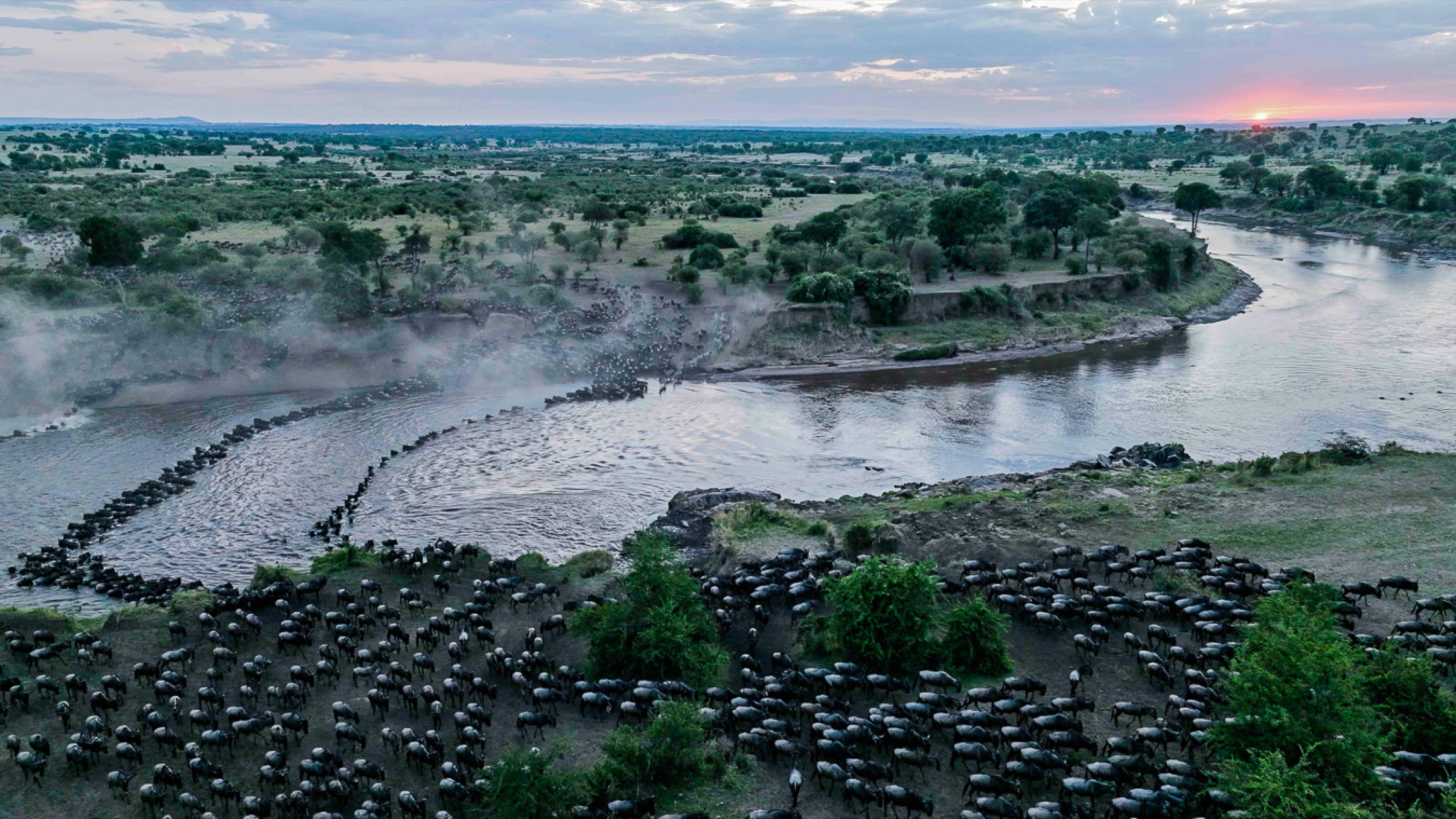
A photo tour built around the Great Migration in the Maasai Mara. Every year between July and September more than a million wildebeest push north out of Tanzania into the Mara, and to reach the grazing they have to cross the crocodile-held Mara and Talek rivers. It is one of the genuine wildlife spectacles of the world, and it is also one of the hardest to photograph well: the herds mass on a bank, hesitate, turn back, and then commit all at once.
We work the crossing points properly — sitting on a build-up for hours if that is what it takes, rather than driving between them — and we are out before first light and back hard into the last two hours of the day. The migration draws the predators in with it, so lion, cheetah and leopard hunting and raising cubs on and around the plains are as much a part of the trip as the river.
Seven nights at MLIMA | Maasai Mara, our own camp, in a group of six with a maximum of three people to a vehicle. Timed for August and September, the short dry season, when the herds are in the Mara and the mornings are cold and misty before the sun burns through.
Itinerary
Mlima Mara · Maasai Mara
Arrive in Nairobi and overnight near the airport. Everything from the moment of landing to the moment of flying home is taken care of — the only things to arrange independently are the international flights into Nairobi and the Kenyan visa.
Mlima Mara
Seven nights at MLIMA | Maasai Mara with the days driven by where the herds are. We leave camp in the dark to be on a crossing point or with a pride at first light. When a herd begins to gather on a bank we commit to it and wait — a crossing can build for hours and then happen in ninety seconds — with the vehicle positioned and lenses pre-focused on the entry point, watching the crocodiles below and the cats on the far bank who are waiting for exactly the same moment. When nothing is building on the river we work the plains: the endless columns of gnu and zebra under big sky, dust hanging gold behind a running herd, and the lion, cheetah and leopard that follow the migration in. Afternoon storm build-ups give the shafts of light this landscape deserves. Evenings are for backing up and for planning the next morning around the herds' movement.
A final morning on the river or the plains if the schedule allows, then a last breakfast in camp before the run out to the airstrip.
A final morning on the river or the plains if the schedule allows, then back to Nairobi for onward flights.
Photography notes
A river crossing dictates the kit. Most of the year's defining frames happen when the wildebeest mass on a bank and finally commit to the water, so a long telephoto is the workhorse: a 100-400mm or 200-500mm zoom is ideal because the herds pile up at unpredictable distances and you want to reframe from a wide 'thousands on the bank' shot to a tight 500mm+ portrait of a single animal lunging through the Mara or Talek river without changing lenses. A second body wearing a 24-70mm or 70-200mm earns its place fast: the crossings kick up spray and dust, the light goes hard and dramatic, and the wide-angle 'endless line of gnu on the plain under a big sky' is as much the story as the frame-filling crocodile strike. We shoot from open-sided 4x4s, so a beanbag over the window ledge or roof edge is far more useful than a tripod, and we will sit on a crossing point for hours if the herds are building. Anticipate the behaviour: herds gather, hesitate, turn back, and then a single animal breaks and the rest follow in seconds, so pre-focus on the entry point, set a high frame rate and a shutter of at least 1/1600s to freeze the leap and the splash, and watch the crocodiles and the far-bank cats who are waiting for exactly the same moment you are.
This is Mara light at its best. In August and September we are working the short dry season, so mornings are cold and often misty before the sun burns through — we leave camp in the dark to be on the crossing points or with a big-cat pride at first light, when the low golden sun rakes across the grass and the dust hangs gold behind a running herd. The middle of the day is harsh and high-contrast, good for scouting, resting the light and photographing behaviour at the crossings if the herds are moving, and we come back hard in the last two hours before dusk. Afternoon build-ups of cloud and the occasional dramatic storm give you moody skies and shafts of light that suit the scale of the place. The migration also draws the predators in to hunt and raise cubs, so budget time and long glass for lion, cheetah and leopard on and around the plains — patient, low-angle work from the vehicle, shooting into the light for rim-lit portraits and waiting on behaviour rather than chasing it.
What to bring
Camera equipment
- Long telephoto zoom - a 100-400mm or 200-500mm is the working range for crossings and big cats at variable distance
- Second body with a 24-70mm or 70-200mm for herd-in-landscape frames and the wide migration story
- Two camera bodies if you can - swapping lenses in the dust and spray of a crossing loses you the moment
- Beanbag for shooting off the vehicle window ledge or roof edge (far more useful here than a tripod)
- Fast, high-capacity memory cards and plenty of them - burst shooting at crossings fills cards quickly
- Spare batteries and a nightly backup drive or laptop; charging in camp can be limited
- Rocket blower, lens cloths and a rain/dust cover - fine Mara dust gets into everything
- A polariser and a few ND stops for cutting glare on water and shooting big skies
Clothing
- Lightweight, breathable layers in neutral, muted colours (greens, browns, khaki); avoid bright colours and camouflage
- A genuinely warm fleece or jacket plus a hat and gloves for the cold, dark early-morning game drives
- A light rainproof or windproof shell - August-September can throw sharp afternoon showers and storms
- Sun hat with a brim, high-factor sunscreen and good sunglasses for the harsh midday light
- A buff or scarf and lightweight long sleeves and trousers against sun, dust and biting insects
- Comfortable closed shoes or boots for camp and the occasional walk; sandals for downtime
Documents, health & practical
- Valid passport with several blank pages and the Kenyan entry authorisation arranged in advance - check current visa/eTA requirements before you travel
- Speak to a travel clinic about anti-malarial prophylaxis - the Mara is a malaria area - plus routine and recommended vaccinations
- Carry a yellow-fever certificate if your wider routing requires it; check requirements for your itinerary
- Comprehensive travel and medical insurance including emergency evacuation cover
- Insect repellent (DEET-based), a small personal first-aid kit and any personal medication in your hand luggage
- Soft-sided duffel rather than a hard case - light-aircraft transfers to the Mara have strict weight and bag limits
- Headlamp or torch for camp after dark, and cash in small denominations for tips and extras
Inclusions / Exclusions
Inclusions
What is included in the tour cost:
- Call prior to our departure, with John Haskew, to run through preparations, kit and ensure we are ready to start photographing before arriving.
- Meeting on arrival at Nairobi and transfer to hotel on the first night.
- Bed and breakfast at the hotel on the first night.
- All road transfers and internal flights in Kenya.
- Full board accommodation for the duration of the stay in the Maasai Mara.
- Airstrip transfers in the Maasai Mara.
- Park fees.
- Community fees.
- Experienced, qualified local guide.
Exclusions
Not included in the tour cost:
- International flights to Nairobi (BA flights recommended if flying from the UK).
- eTA (electronic travel authorisation) - cost US / GBP27.
- Personal travel and health insurance.
Film
Here is a film of the Great Migration, made by John.